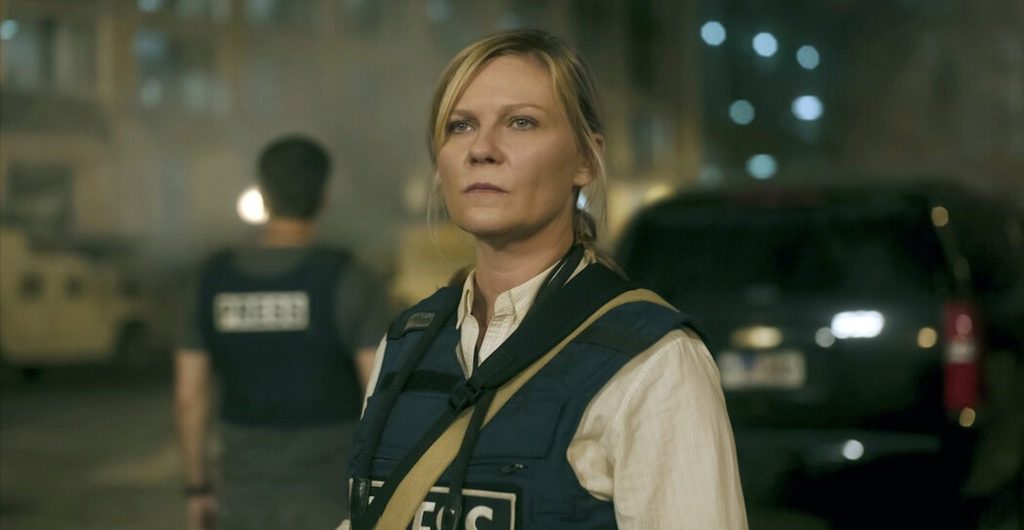
Alex’s Garland’s “Civil War”, released in April of 2024, has renewed relevance with the recent electoral victory of Donald Trump. Indeed, the resurgence of the Maga movement in the November election serves to highlight the the cultural divide between Democrats and Republicans, an ideological divide that could potentially spill over into civil war if these differences in beliefs cannot be mediated in some way. Watching the film in early 2025, the post-apocalyptic setting has an eerie atmosphere that echoes many of the events unfolding before our eyes in the mass media: mountains of rubble in Gaza; toppling statues of Assad in Syria; power black-outs in the Ukraine and wildfires in the Pacific Palisades. Even as I write this review, Trump is making threats to purchase or invade Greenland, a territory of Denmark with its own elected representatives and citizenry.
One might question Garland’s choice of subject matter on the grounds that imagining a future Civil War in the United States of America might in fact normalize the idea for average Americans and bring about an historical recursion of the Civil War of the 1860s which remains a scar on the American psyche and a real threat. Such concerns are highlighted by the opening scenes of the film, set in an spookily quiet New York City, where a suicide bomber (bizarrely cast as a young woman) detonates an explosive back-pack outside an aid distribution depot. Despite the expectation that the viewer might be immersed in an exhilarating war movie on a grand scale, Garland retreats from such direct depictions of conflict (perhaps due to the fairy limited budget of $50M allowed by independent production company A24) and chooses to focus the narrative around the experiences of news photographers Lee (Kirsten Dunst), Joel (Wagner Moura) and Sammy (Stephen McKinley…), who chaperone the young and naive Jessie (Cailee Spaeny) on a risky mission to interview the President (Nick Offerman) before he is overrun by the “so-called” Western Forces. By grounding the narrative in this idealistic group of news photographers, Garland effectively distances himself from either side and refuses to celebrate the spectacle of a future civil war. If we had hoped for some kind of political message or allegiance from Garland, furthermore, such hopes are disappointed by the ambiguous political status of the rebel forces, who are identified only as the secessionist states of California and Texas, states which in fact appear to be ideologically opposed at the present moment: the former embodying the liberal ideology of the Green tech economy and the latter the conversative politicals of a fading oil aristocracy.
The choice of a photographic circle as the focus of the film transforms the picture from a war movie into a psychological journey reminiscent of Apocalypse Now or the more recent Ad Astra. Our primary lens is the main character, Lee, whom is apparently well known for her war photography and is idolized by the younger Jessie, who manages to wangle her way into the risky mission via a flirtatious conversation with the slightly aloof and reckless Joel, who seems to spend most of his on screen-time smoking weed. By viewing the war torn landscape through the eyes of Lee and Jessie – who provides us with many black and white “stills”, which adds an artistic dimension to the cinematography – Garland takes a very detached stance from the conflict, which enables him to avoid any easy identification with either the reigning President or the Western Forces. Yet the use of journalistic detachment to view the scenes of war creates an uneasy tension between the voyeurism of the war photographers in search of the perfect “shot” and the real combat scenes in which uniformed soldiers and plain clothed militia men suffer horrific injuries which are presented to viewers in graphic details. In many scenes, the photographers are embedded with soldiers in their “press helmets”, with Garland often drawing attention to the parallels between “shooting” enemy soldiers and “shooting” pictures that capture the grim reality of war. As they journey closer and closer to the frontline in Charlottesville, the characters become more accustomed to the scenes of madness and atrocity, the soldiers they meet having very little understanding of the purpose behind the war.
Garland’s efforts at remaining politically detached are challenged towards the end of the film, however, when the photographers embed themselves with a company of Western Force soldiers who are storming the White House in search of an embattled President. By positioning the photographers within this unit and using point-of-view shots from the perspective of Jessie’s analog camera, Garland does indeed show a hint of sympathy towards the secessionist forces and henceforth takes the stance of an apologist for the use of military force to topple a tyrannical president. A detail revealed earlier in the film specifies the President is serving a “third term”, suggests that he has either discarded elections or refused to certify results, providing allusions to Trump’s own efforts to deny the outcome of the 2020 election and his subsequent support for the militia men that stormed congress on January 6 of the following year. In the final wash-up, Garland chooses to focus on the experiences of the photographers and the relationship of mentoring between Lee and Jessie, a decision that effectively neutralises any genuine political engagement. By not taking sides, Garland falls back on the anti-tyranny message at the heart of the seventh amendment, suggesting that the use of arms is justified when the principles of Democracy are at stake.
 Bill Martin Jazz
Leave a comment